2026 SEO Campaign Management: Why Campaigns Fail & How to Fix
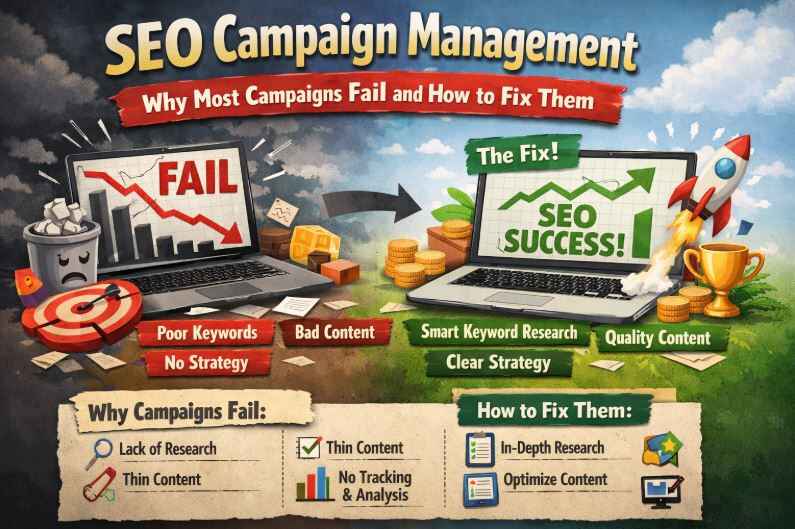
Starting an SEO campaign isn’t hard — making it profitable, predictable, and sustainable is where most businesses fail.
On the surface, SEO looks simple: optimize pages, publish content, build links, and monitor rankings. Many companies do just that — but performance often plateaus, results become inconsistent, and leadership begins to question whether SEO is worth the effort.
The real problem isn’t a lack of effort. It’s execution and ownership. Without treating SEO as a structured system, campaigns quietly stall, opportunities go untapped.
In this guide, we’ll explain why most SEO campaigns fail, how SEO campaign management solves the problem, and what businesses can do to turn SEO into a predictable growth channel.
Why Most SEO Campaigns Fail
SEO campaigns often fail not because SEO doesn’t work, but because it isn’t actively managed.
The most common reasons include:
- Lack of a clear strategy or accountability.
- Pages competing for the same keywords.
- Content published without conversion intent.
- Decisions based on tools rather than performance data.
- SEO is treated as an isolated task instead of a system.
When execution lacks coordination and accountability, effort increases, but results stagnate.
What Is SEO Campaign Management?
SEO campaign management is the ongoing process of planning, implementing, measuring, and adjusting SEO efforts to achieve specific business results — not just rankings or traffic.
This includes:
- Defining clear ownership and goals.
- Prioritizing keywords and pages based on impact.
- Monitoring performance beyond vanity metrics.
- Continuously improving based on data.
Unlike one-time optimizations, SEO campaign management views SEO as a long-term growth system where each action builds on the last.
If SEO feels busy but results are inconsistent, a structured campaign can bring clarity and direction.
How SEO Becomes a Measurable Growth Process
SEO campaign management is often misunderstood.
Many businesses assume it means “doing more SEO” — more content, more optimization, more reports. In reality, management has little to do with volume.
True SEO campaign management is about:
- Clear ownership.
- Strategic priorities.
- Ongoing adjustments based on performance data.
- Align with business goals, not empty metrics.
When SEO is not actively managed, it becomes fragmented. Pages compete with each other. Content is published without a clear ranking or conversion goal. Links are acquired without a long-term strategy. Reports show activity, but no insight.
The result?
The work gets done, but the results don’t improve.
SEO management turns it from a guessing game into a controlled growth channel.
Building a Website That Supports Sustainable Organic Growth
All SEO campaigns start with the website. If the website structure is poorly laid out, nothing built on top will work effectively. A strong website ensures that SEO efforts drive traffic, leads, and revenue.
Building a New Website
One needs to choose a website builder that is adaptable, fully supported, and designed for long-term SEO. WordPress is one of the most popular website builders because it allows for extensive control and customization and offers great extensibility. There are many plugins that can improve the entire site.
Some WordPress plugins to consider:
- Yoast SEO – helps with optimizing H1 tags, meta tags, and performing readability checks.
- Cache Tools or WP Rocket – improve page load times and overall site speed.
- Schema Tools – help search engines understand your page titles and structure.
Key Pages to Include:
- Home
- About
- Services
- FAQ
- Contact
From there, the structure can be built based on key opportunities, business priorities, and needs rather than design trends. Avoid using a one-page website design; a clean one-page website limits SEO potential. A site with multiple pages can help you:
- Target keywords
- Address different stages of the buyer’s journey
- Build content authority over time
Optimizing an Existing Website
Before you make any small tweaks, do a quick, honest, step-by-step SEO audit, considering the following:
- Does the site load quickly and work well on mobile devices?
- Is the design modern and user-friendly, or is it outdated?
- Is the platform flexible enough to support technical SEO improvements?
- Are your meta tags, H1 tags, image alt text, and URL structure optimized for both users and search engines?
Tools like SEMrush and Google Keyword Planner provide insight into your site’s performance and help identify areas to rank high and justify investment in content on specific pages. The technical health, usability, and structure of a site directly affect SEO performance and conversions. A site that is confusing to users or limits optimization may look good, but it will stifle results compared to a well-designed site.
Why Websites Underperform Without Ongoing Optimization
Many companies over-invest in design or under-invest in structure. Without monitoring, sites can look great but fail to support growth because SEO, if considered at all, is an afterthought. Strategic site management ensures that:
- Pages are optimized from the ground up
- Keyword opportunities guide your structure and content
- SEO contributes to long-term business growth, not just aesthetics
Explore Marketing Guides & Insights
| Online Advertising Campaigns | Digital Marketing Trends |
| SEO Services for Leads | Digital Marketing Advantages |
| Technical SEO – Fix & Rank | Local SEO Ranking Factors |
Developing a Keyword Strategy Based on Real Search Behavior
Keywords are the backbone of any SEO campaign, but they’re also where many campaigns quietly go astray.
The mistake starts with assumptions. Businesses often target keywords they think customers use, rather than how real people actually search for them. A successful keyword strategy requires a different perspective — from internal language to user intent.
How to Identify Real Opportunities
Start with Google itself. Autocomplete suggestions and related searches are based on real-world behavior, not theory. They show how users define problems, compare options, and express intent.
Keyword tools help validate ideas by showing:
- Search volume
- Competition
- Commercial value
Also important is analyzing what you already rank for. Often, the fastest gains come from optimizing keywords that sit just outside the top positions rather than chasing entirely new keywords.
A strong strategy starts broad, then narrows. Expect to discard ideas. The goal isn’t quantity — it’s relevance and winnability.
Why Poor Keyword Prioritization Slows Growth
Without prioritization, keyword lists grow uncontrollably. Multiple pages target overlapping keywords, internal competition increases, and effort gets diluted. Rankings stall not because the keywords are wrong, but because no one is deciding what’s most important. Many SEO campaigns fail because strategy and execution aren’t aligned. Digital Marketing CDN helps businesses implement structured SEO systems that actually drive results.
On-Page Improvements That Drive Rankings and Leads
Once your target keywords are identified, your site’s structure and content should be organized around them. Each important keyword should map to a specific page. Similar terms can coexist naturally, but unclear mappings create confusion for both users and search engines.
Example:
- “SEO Services” → Dedicated SEO Services page
- “PPC Management” → Paid Advertising Services page
- “Social Media Marketing” → Social Media Management page
Each page has a clear focus, reducing overlap and helping search engines understand relevance.
Titles and Meta Descriptions
Every page needs a clear, concise title and meta description that:
- Naturally incorporates the target keyword or phrase
- Clearly communicates value to users
- Reads well and avoids awkward phrasing
- Steers clear of gimmicks or keyword stuffing
Example:
- Title: SEO Services That Drive Traffic and Conversions
- Meta Description: Professional services designed to improve search visibility, increase traffic, and convert visitors into customers.
If it sounds awkward when read aloud, it probably won’t convert.
Heading Structure and Content Hierarchy
Pages should have:
- One clear H1
- Supporting H2s and H3s that organize content logically
Example:
- H1: Professional SEO Services for Growing Businesses
- H2: Our Optimization Process
- H2: How We Boost Online Visibility
- H3: Keyword Research and Content Planning
Headings are more than just visual elements—they provide context and hierarchy that search engines rely on to understand the content.
Content That Serves User Intent
Each page should answer questions, solve problems, and guide users. Thin content written solely to “cover keywords” rarely performs well.
Example:
Instead of repeatedly saying “SEO services,” explain:
- Common ranking challenges
- How your process works
- What results clients can realistically expect
Search engines reward useful content, and users reward clarity.
Images, URLs, and Internal Linking
- Optimize images for performance and relevance
- Use clean, descriptive URLs
- Naturally link related pages to strengthen site structure
Example:
- URL: /seo-services/
- Alt text: SEO strategy planning process
- Internal links: Connect this page to related services, such as content marketing or PPC management
This approach improves your website’s structure, distributes authority, and supports organic growth.
Why On-Page Performance Declines Over Time
On-page optimization often happens in isolation. Pages are optimized once and forgotten. Without continuous review and adjustment, performance deteriorates as competitors improve and search behavior changes.
Example:
As search intent evolves (for example, increasing interest in automation or AI-powered marketing), pages must be updated to stay aligned with how users discover and evaluate services.
Optimizing Google Business Profile for Local Visibility
For businesses that serve specific locations, a Google Business Profile is a critical part of SEO.
A complete, consistent profile helps search engines trust your business and improve visibility in local results.
Key elements include:
- A valid name, address, and phone number
- Complete business details
- Updated photos
- Regular posts
- Review engagement
Confusing information on the web confuses search engines and hurts local rankings.
Why Local Visibility Declines
Profiles are often claimed, filled out once, and ignored. Over time, outdated information, lack of engagement, and lost reviews can erode local visibility — even if the website itself is great.
Managing SEO vs. Doing SEO: The ROI Difference
This is where most companies reach their limit.
Doing SEO focuses on tasks:
- Publishing content
- Optimizing pages
- Monitoring rankings
Managing SEO focuses on results:
- Which pages generate leads or revenue
- Which keywords deserve ongoing investment
- What to improve next and what to stop doing
Without management:
- Strategy competes with daily execution
- Prioritization becomes reactive
- Decisions are based on tools instead of judgment
- No one is accountable for the results
With management, SEO becomes predictable. Each optimization builds upon the previous one instead of competing with it.
Who Benefits Most From Structured SEO Oversight
SEO campaign management isn’t necessary for every business.
It’s usually the right decision when:
- SEO is already generating leads, but the results seem inconsistent
- You have rankings, but the competition is catching up
- Marketing teams are implementing tactics without strategic oversight
- SEO performance is impacting the sales pipeline, forecasts, or revenue
When search visibility influences how customers find or evaluate your business, unmanaged SEO becomes a burden.
What Businesses Expect From Organic Growth
Despite all the focus on ranking and traffic, most businesses are looking for something simpler:
Predictability.
They want to know:
- Where growth will come from
- Which pages are worth investing in
- How SEO contributes to revenue over time
Well-managed SEO doesn’t promise immediate results. It delivers consistent gains that reduce reliance on paid channels and improve acquisition efficiency.
With proper management, SEO becomes an infrastructure, not a monthly experiment.
How Long Does an SEO Campaign Take to Work?
Websites should see significant improvement in SEO campaigns within 3 to 6 months, with even more compounding results from 6 to 12 months. Several factors influence the timeline:
- Competition: SEO efforts will take longer to show results in highly competitive industries.
- Consistency: Building links, creating pages with optimized content, and keeping on-page SEO techniques up to date will yield faster results.
- Quality: Regularly updated content helps optimize your site and improve SEO performance.
- Ongoing strategy and management: SEO is a long-term strategy, and flexible management enables you to maximize growth potential.
Results should improve and become more measurable with each passing month.
Final Thoughts: Making SEO a Predictable Growth Channel
SEO works best when it’s treated like any other growth channel: with ownership, intent, and long-term thinking.
When strategy, execution, and accountability align, results are achieved.
When they don’t, effort is silently wasted.
If SEO is already playing a role in your marketing mix — or needs to — management can be the difference between progress and disappointment.
This is usually the point where clarity is more important than overdoing it.
Ready to turn your SEO campaigns into a predictable growth engine? Digital Marketing CDN can help you take control of your SEO strategy, prioritize the right keywords, and optimize your website for long-term results