Top Local SEO Ranking Factors in 2026 for Local Businesses
Every business owner recognizes this moment:
Someone is physically nearby, looking for the exact product or service you offer — and you want to be the business they search for first.
This expectation is not imagined. It’s measurable, fast, and increasingly decisive.
In 2025–26, nearly half of all Google searches will have local intent, meaning people are actively looking for a nearby solution. If your business doesn’t show up when someone in your city searches for what you sell, you’re not just missing out on a click — you’re missing out on revenue.
Today, local SEO is no longer theoretical.
This is where search becomes foot traffic, calls, and purchases.
This guide explains how local search works in 2026, which ranking factors matter most, and how local businesses can turn visibility into real calls, visits, and revenue.
What Is Local Search Optimization?
In local search optimization, the goal is to make your business easy to find for people searching nearby.
For businesses in any city in Canada — Toronto, Vancouver, Calgary, Halifax, and beyond — it is the difference between being discovered by local customers or getting lost in the crowd.
Local SEO vs. Traditional SEO in Practice
Unlike traditional SEO, which targets national or broad visibility, local SEO is location-based.
The goal: not just to rank, but to rank for local customers actively searching in the right place at the right time.
How Google Evaluates Local Businesses in Local Search
Any business with a storefront, office, or service area should prioritize local SEO.
It ensures Google connects your business with people actively searching for your products or services in your city or neighborhood.
Where Local Businesses Appear in Search Results
Local SEO determines whether your business appears in:
- Google Maps results
- Google 3-Pack
- Local organic search listings
- Voice and AI-driven local queries
The Main Goal of Local Search Visibility
At its core, local SEO helps Google answer three key questions about your business:
- What do you do?
- Where are you located?
- Can customers trust you?
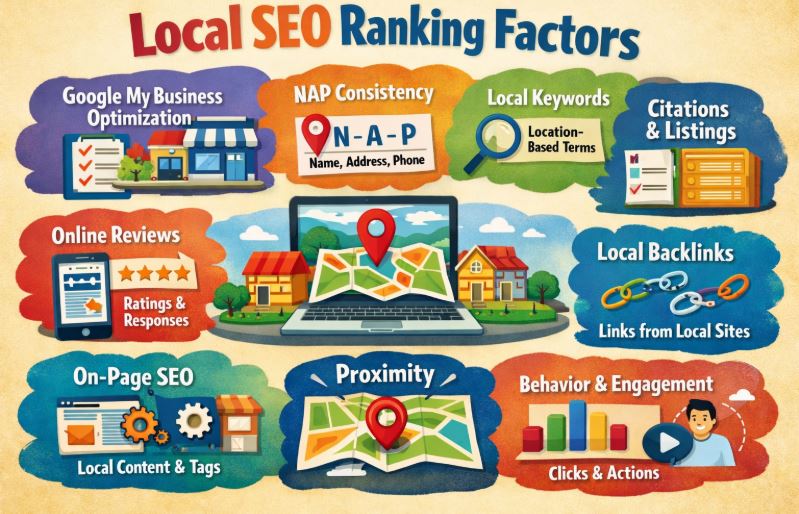
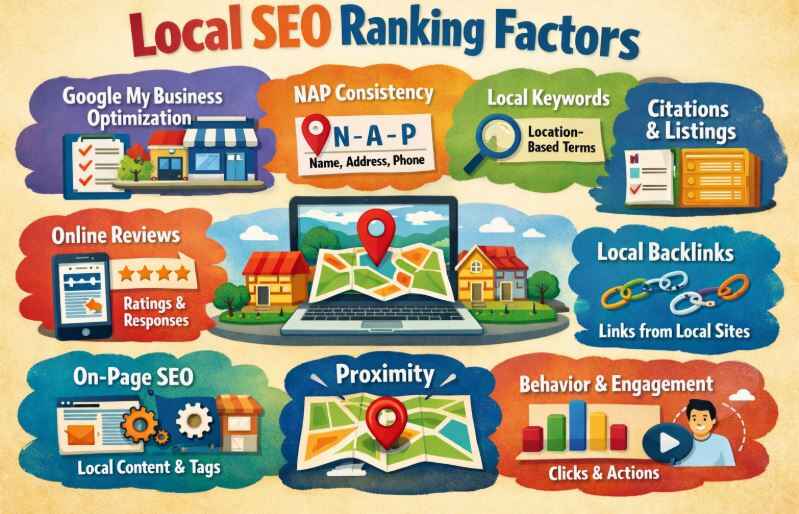
Core Local SEO Ranking Signals Google Uses
Google looks at a combination of signals:
- Google Business Profile accuracy and activity
- Business location and proximity to the searcher
- Reviews, ratings, and engagement
- Consistent Name, Address, and Phone information (NAP) across the web
- Website relevance, speed, and mobile usability
- Local referrals and backlinks
- Real-world engagement (calls, visits, clicks, direction requests)
Why This Matters in 2026
- Targets high-intent searches — people actively deciding where to go, who to call, or what to buy
- Turns visibility into action, not just awareness
Real-Life Local Search Examples
Examples of high-intent searches:
- “Plumber near me in Calgary”
- “Best sushi Toronto”
- “Family doctor in Ottawa”
- “Emergency vet Vancouver”
When your business appears in these results — and your information is accurate (hours, location, reviews) — customers can immediately call, book, or visit.
Why Local SEO Converts Faster Than Traditional SEO
- Traditional SEO → drives awareness
- Local SEO → drives action:
- Phone calls
- Store visits
- Appointments
- Purchases
- Phone calls
Final Insight: Local SEO isn’t just a marketing tactic — it’s the foundation of customer acquisition in a location-based economy.
The Opportunity for Local Businesses in 2026
Let’s talk about real behavior, not opinions:
- 46% of all Google searches in Canada have local intent.
- Roughly 1.5 billion “near me” searches occur every month (around 50 million per day).
- 28% of local searches lead to a purchase within 24 hours.
- 78% of local mobile searches result in offline purchases.
- 76% of people who search for something nearby on a smartphone visit a business within a day.
- Over 57% of local searches start on mobile devices.
- Nearly 90% of users who search for a local business on mobile either visit or call.
These are not awareness metrics. They are high-intent, high-conversion moments with a direct line to revenue.
In practice, local search is no longer top-of-funnel.
It is bottom-of-funnel with urgency.
Local search is how customers make decisions — often in minutes
For most consumers, local search is not a “nice to have.”
It’s how people decide where to spend their money.
Consumers don’t wander around a neighborhood hoping to discover a business by chance.
They search, compare, and then act.
Local search results directly influence:
- Trust
- Reputation
- Decision-making
If your business doesn’t appear when someone nearby is actively searching, you’re losing visibility — and that visibility goes straight to a competitor.
What Local Search Really Is (No Buzzwords)
Local search exists for a reason:
Real-time intent is the most powerful way to help search engines connect nearby users with relevant, trusted businesses.
It’s not just about keywords.
Local visibility is built on:
- Relevance
- Reputation
- Engagement
- Context
- Proximity
Together, these signals tell Google:
“This business is real, relevant, and trusted — and deserves to be shown now.”
That’s why local SEO levels the playing field.
Small and medium-sized businesses aren’t competing on national advertising budgets or brand recognition.
They’re competing on:
- Convenience
- Relevance
- Location
- Trust
Consumers want to support local businesses.
What’s holding them back isn’t intent — it’s discovery
Why Local Visibility Drives Faster Decisions
Discovery behavior has changed:
Mobile is now the dominant channel for local discovery.
Searches often occur while consumers are on the move.
Consumers expect instant answers: hours, directions, reviews, and contact options.
Google rewards businesses that provide:
- Fast mobile performance
- Clear, accurate information
- Easy interaction
Because local searches convert quickly, this traffic is not exploratory—it drives decisions.
Why the Google 3-Pack Is the Most Valuable Real Estate in Local Search
When Google detects local intent, it doesn’t start with ten blue links.
It shows three businesses at the top of the page, paired with a map — the Google 3-Pack.
Those three listings receive:
- Higher call volume
- More website clicks
- More foot traffic
- Stronger perceived credibility
The 3-Pack instantly answers:
- Where is it?
- Are they open?
- Can I trust them?
- How do I contact them?
If your business depends on local customers and you’re not competing for this placement, you’re starting every month at a disadvantage.
How Businesses Earn Visibility in the Google 3-Pack
There is no shortcut.
Visibility is achieved through:
- Relevance
- Trust
- Accuracy
- Engagement
Most of these signals flow through your Google Business Profile.
Think of your Business Profile as your public résumé for local search.
A partially completed profile sends weak signals.
A neglected one sends negative signals.
Strengthen Your Google Business Profile in 2026: 8 Key Steps
Your Google Business Profile (GBP) is the digital face of your business—the first thing potential customers see. In 2026, a well-optimized GBP is critical for local search success, as it helps customers make a strong first impression, understand your products and services, and find you in local searches. Fully optimized profiles also drive foot traffic, phone calls, and click-throughs.
Here’s how to strengthen your GBP and maximize its impact:
1. Verify and Fully Own Your Listing
Claim and verify your business to ensure trust and authenticity. Verified ownership gives you control, improves accuracy, and allows engagement with customers. Unverified profiles often underperform and lose visibility.
2. Display Your Address Clearly
Accurate address information helps Google confidently place your business on the map and show it to nearby searchers. This applies to service-area businesses as well.
3. Publish Updates Consistently
Share posts, offers, and announcements regularly. Active profiles signal relevance to Google and give customers a reason to choose your business.
4. Add Fresh, Real Photos
Use real images of your interior, exterior, team, and recent work. Stock photos underperform. Businesses that update photos regularly see higher engagement, increased familiarity, and more trust.
5. Manage Q&A Proactively
Anyone can answer questions on your profile. Monitor and respond promptly to prevent incorrect information from persisting, which can damage credibility.
6. Respond to Every Review
Reviews impact rankings, and your responses influence conversions. Customers judge how you handle feedback, not just the feedback itself.
7. List Services and Products Clearly
Detailed listings help Google determine relevance and allow customers to self-qualify for your offerings. Include descriptions, pricing, and high-quality images when possible.
8. Keep Everything Current
Maintain accurate hours, phone numbers, seasonal changes, and other key information. Stale data reduces trust, while Google rewards accuracy.
Why Google Business Profile Optimization Matters in 2026
A 2026 study found that fully optimized profiles can generate 7× more business than incomplete ones.
Google now combines AI-powered summaries with up-to-date profile data to generate:
- Featured snippets
- Local map packs
- Knowledge panels
This boosts visibility beyond traditional search results.
Businesses with complete, active profiles see measurable improvements in:
- Local search visibility
- User engagement
- Conversions
Expert Insight:
Customer reviews, FAQs, and posts tailored to trending search queries influence AI-driven search recommendations and map rankings more than ever. Monitor and update them regularly to stay competitive.
Reviews and Reputation: Ranking Signal and Conversion Multiplier
- Reviews are not optional. Businesses with more reviews rank higher.
- Recency and authenticity are important.
- 88% of consumers trust online reviews as much as personal recommendations.
- Reputation is both a visibility factor and a deciding factor.
NAP Consistency: Trust Signals Many Businesses Ignore
Your Name, Address, and Phone number must match everywhere:
- Website
- Directories
- Social Profiles
- Review Platforms
Even small variations create confusion. Confusion reduces trust. Low trust weakens rankings.
Best Practice:
Regularly audit your NAP across all platforms using tools like Whitespark, Moz Local, or BrightLocal. Make sure each listing matches your Google Business Profile to maximize local search visibility and credibility.
Listings and Citations That Boost Visibility
Not all citations are created equal. Focus on:
- Trusted directories
- Industry-specific platforms
- Regional and niche sites
Google cross-references these sources to verify legitimacy. Accuracy beats volume.
Best Practice:
Audit your listings regularly using tools like Moz Local or BrightLocal, and make sure your NAP is consistent across all citations to maximize local search visibility and trust.
Backlinks with Geographic Relevance
Links from:
- Local organizations
- Industry platforms
- Regional publications
Why it matters:
- Strengthens geographic credibility
- A handful of strong local links can outperform dozens of generic links
Webpage Optimization for Local Traffic
Your website needs to define:
- What services do you provide
- An example is: “Residential and commercial plumbing services.”
- What geographic locations you serve
- An example is: “Toronto, Mississauga, and the Greater Toronto Area (GTA).”
- Who do you provide services to
- An example is: “Homeowners, landlords, and small businesses in Ontario.”
Most Important Factors
- Targeting of relevant local keywords
- Examples: “Toronto emergency plumber” or “Mississauga licensed plumber.”
- Site performance on mobile
- Example: Make sure your site is quick-loading for users searching “near me” in Canada.
- Use of structured data (schema)
- Example: Incorporate the LocalBusiness schema for your business, including your Canadian address, phone number, service locations, and hours of operation.
- Content that is relevant to your service area and answers service-area-specific questions
- Examples:
- Dedicated city page: “Toronto plumbing services.”
- Blog: “Backwater valves: Do Toronto homes need them?”
- FAQ: “What is the price of plumbing services in Ontario?”
- Examples:
The Mobile Experience is Non-Negotiable
Local searches happen on phones – often when users are already on the move.
Slow pages, messy layouts, or unreadable text:
- Hurt rankings
- Kill conversions
- Send customers elsewhere
Google measures it. Users notice it immediately.
Proximity Is Real — and Unavoidable
You cannot fake location.
Google uses real-world distance as part of its ranking logic.
What you can control is clarity: accurate addresses and consistent signals across the web.
The Multi-Channel Reality of Local Discovery in 2026
Local SEO is no longer just Google.
Customers are finding businesses across Canada on:
- Google Maps
- Instagram
- TikTok
- AI platforms like ChatGPT
Businesses that increase their visibility on social and video consistently generate stronger leads. Local rankings are important — but they’re not the whole picture.
The Bottom Line: Winning Local Search in 2026
For Canadians, local SEO is no longer optional.
This is how consumers:
- Discover
- Compare
- Decide
Paid ads buy attention. Organic local rankings build trust, consistency, and compound returns. If someone nearby is searching for what you offer and you’re not showing up, your competitor will be.
Local SEO in 2026 is a discipline:
- Clean, accurate listings
- Optimized mobile experiences
- Active review engagement
- Strategic local content
- Awareness across search and social channels
Do it consistently and you won’t just show up — you’ll win customers.
Local search continues to deliver some of the highest conversion rates in digital marketing — and that’s not rhetoric. It’s fact, backed by data.
At Digital Marketing CDN, we help businesses optimize their local presence across search and social channels, ensuring you show up for the right customers at the right time. Call us today at (250) 815-5442 to get started!
Essential SEO Topics You Need to Know
| Local SEO Guide | Best Digital Marketing Agency |
| Website Marketing Strategy | Social Media Marketing Agency |
| Local SEO Strategies | Optimize Your Google Profile |