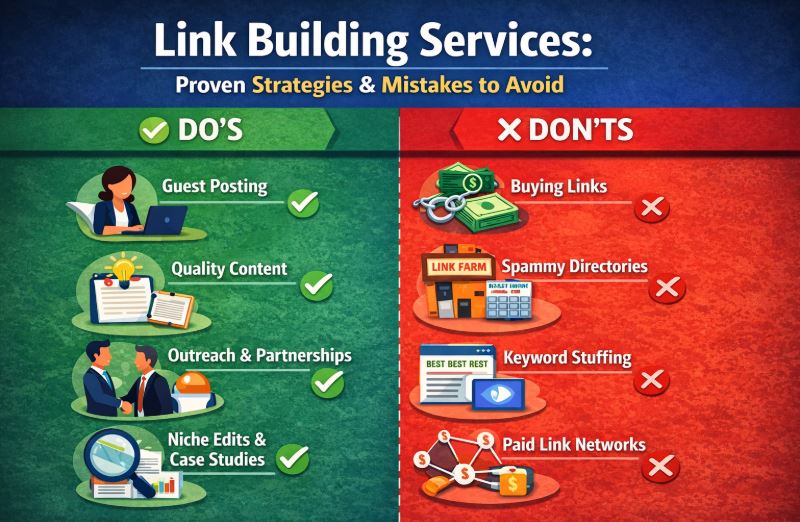
Link Building Services: Proven Strategies and Mistakes to Avoid
If your goal is consistent search visibility — not short-lived traffic spikes — backlinks still matter. A lot.
But in 2026, it’s not just about having links; it’s about building them the right way. Search engines are more selective than ever, and poorly chosen backlinks can quietly undermine long-term performance.
Backlinks are no longer about volume, tricks, or shortcuts. They’re evaluated in context — based on trust, relevance, and user intent. Many sites struggle not because they lack links, but because they pursue the wrong ones or build them in ways that harm SEO results.
At Digital Marketing CDN, we’ve seen what works, what used to work, and what steadily erodes performance over time. Below is a modern breakdown of our approach to link building services, including:
- What backlinks are and why they still matter
- Common tactics that hurt rankings
- Proven strategies that actually drive sustainable results
What This Looks Like in Real Campaigns
At Digital Marketing CDN, we’ve audited and rebuilt link profiles across a wide range of industries — from local service businesses to national brands. We’ve also worked extensively with Canadian businesses, including Toronto-based startups and Vancouver e-commerce companies.
In nearly every case, ranking stagnation wasn’t caused by a lack of backlinks — it was due to misaligned or low-quality links.
Case Study: Calgary Plumbing Service
In a recent campaign, we:
- Removed low-relevance directory links
- Redirected efforts toward a small number of high-value editorial placements
The results were immediate and measurable:
- Noticeable ranking stabilization within weeks
- Stronger keyword positioning without increasing link volume
- Improved performance across multiple relevant pages, not just one URL
Key Takeaways
Link quality and context consistently outweigh link count. A few high-value, relevant backlinks can deliver better long-term results than dozens of generic or low-trust links.
Why Backlinks Still Matter in 2026
An inbound link is simply another website that references one of your pages. But not all referring domains carry the same weight.
Search engines use these links as trust signals. When authoritative, relevant websites cite your content, Google recognizes your site’s credibility and signals that it deserves a strong ranking. The result is:
- Greater visibility
- More stable rankings
- Higher-quality traffic over time
Also Read: Why Your Website Isn’t Ranking – SEO Fixes That Work
As Google’s systems increasingly evaluate context, intent, and topical relevance, backlinks function less like votes and more like credibility signals within a broader ecosystem. A single contextual link from a credible, topically aligned site can influence your ranking more than dozens of low-quality links from random sources.
Today’s algorithms focus on why a link exists, not just that it exists, rewarding editorial intent and discounting low-value or manufactured signals. Modern algorithms typically evaluate:
- Who links to your site
- Why they link
- How naturally the link fits within the content
Common Link-Building Mistakes That Hurt Rankings
Before focusing on what works, it’s important to understand what actively harms performance. Many of these tactics still circulate in SEO forums, but they either provide little value or introduce real risk.
1. Chasing Link Quantity Over Link Value
A bloated backlink profile with weak or irrelevant domains can do more harm than good. One strong, relevant link consistently outperforms dozens of low-trust placements. Measuring success by link count alone tracks the wrong metric.
2. Ignoring Topical Alignment
Links should be meaningful to both users and search engines. A finance site earning links from unrelated blogs or directories signals randomness rather than authority.
3. Submitting to Mass Directories
Submitting to hundreds of generic directories sends low-trust signals. Outside a few legitimate platforms—like Google Business Profile or certain niche directories—most provide little real value.
Tip for Canadian businesses: Focus on credible local platforms such as the Canadian Chamber of Commerce, Yelp Canada, or provincial business associations.
4. Buying Links
Paid links intended to manipulate rankings fall directly into patterns that modern link spam detection systems identify, especially when placement, anchors, and domains lack editorial justification.
5. Publishing Thin Content Just to Link To
Content that doesn’t educate, solve a problem, or add perspective rarely earns genuine backlinks. Depth consistently outperforms frequency—quality always wins over quantity.
6. Over-Optimizing Anchor Text
When every backlink uses the same keyword-rich anchor, it looks unnatural—because it is. Natural link profiles include brand mentions, partial phrases, and contextual language.
7. Dropping Links in Blog Comments
Comment sections are usually moderated and “nofollow.” Forced self-promotion not only provides little SEO benefit but also damages brand perception. Comment to contribute, not to link.
8. Neglecting Local Link Building
For region-specific businesses, generic backlinks alone won’t establish geographic relevance. Local publications, chamber sites, and regional platforms directly influence local search performance.
Also Read: Local SEO Ranking Factors for Businesses
9. Relying Solely on Cold Outreach
Cold emails can work, but relationship-based link building is far more effective. Vendors, partners, clients, collaborators, and industry peers often represent the most natural backlink opportunities—yet many brands fail to leverage them.
Key SEO Topics You Should Know
| Off-Page SEO Services | Best SEO Services |
| Lead Generation Strategies | Off-Page SEO Strategies |
| Cross-Linking in SEO | Common SEO Mistakes |
Key Points on Backlinks
- Not all backlinks are neutral. Low-quality, irrelevant, or poorly placed links can actively weaken trust signals, rather than simply being ignored.
- Relevance consistently trumps quantity. A small number of links from credible and thematically relevant sources performs better than a large number of generic links.
- Artificial link patterns are easier to detect than ever. Over-optimized anchor text, paid placements, and mass submissions confuse modern link spam detection systems.
- Links are evaluated in context, not in isolation. Who links to your site, why, and how naturally the link fits into the content all influence its value.
- Local signals are important for regional rankings. For businesses targeting specific markets, local publications, associations, and industry platforms are essential indicators of authority.
- Shortcuts have a cumulative negative effect over the long term. Time-saving tactics often have a negative long-term impact, while links obtained through quality editorial content help build lasting authority.
Effective Link-Building Strategies That Work Today
Here are the methods Digital Marketing CDN relies on to create lasting links:
1. Publish Content That Is Actually Cited
Links are earned when content becomes a resource, not just for SEO. Content that naturally attracts links includes:
- Original research and industry data
- Case studies and benchmarking
- Detailed how-to guides
Example: We created a property tax calculator for Ontario homeowners. This interactive tool earned backlinks from local real estate blogs and Toronto neighborhood websites, showing how helpful, locally relevant content generates high-quality links.
If someone is already writing about your topic, your content should give them a reason to cite you instead of repeating what already exists.
2. Create Useful Tools, Not Just Articles
Free tools earn links quietly and consistently. Calculators, templates, checklists, and interactive resources are often cited by bloggers, trainers, and specialized websites without promotion.
Tip: Tools must solve a real problem — not exist solely to generate links.
3. A Strategic and Respectful Approach
Targeted outreach works best. Focus on:
- Writers already covering your topic
- Websites linking to similar resources
- Publications where your expertise adds value
Effective outreach isn’t about asking for favors — it’s about offering something useful to your audience.
4. Guest Posting: Quality Over Quantity
Guest posting still works if done judiciously. Focus on sites that:
- Target a similar audience
- Maintain strict editorial standards
- Have a real readership
Canadian Example: Target specialized blogs like the Canadian Marketing Association, Vancouver Startups, or Toronto Business Times. A high-quality guest post on a relevant local site consistently outperforms dozens of low-quality articles.
5. Increase Your Content’s Visibility on Social Media
Social links don’t directly boost rankings, but visibility creates opportunities. When content gains traction on LinkedIn, X, or industry communities, it often reaches journalists and site owners who may publish followed links.
Think of social media as a distribution tool, not an SEO tool.
6. Replace Broken Links
This strategy works because it is genuinely helpful. Identify pages linking to outdated or broken resources and offer your relevant content as a replacement. Website owners fix the problem, and you earn a contextual link.
7. Analyze Competitors’ Link Strategies
If competitors rank higher, their links are often a factor. Analyze:
- Where their links come from
- Which content attracts them
- Anchor text usage
This isn’t copying — it’s understanding what the market already rewards.
8. Retrieve Brand Mentions Without Links
Many brands are mentioned without links. Monitoring tools help you quickly find these opportunities. A polite request for attribution often converts because the hard part — the mention — already exists.
9. Prioritize Content Partnerships Over One-Off Links
Ongoing collaborations outperform transactional placements. Examples include:
- Co-authored guides
- Joint research
- Podcast appearances
- Shared resources
Partnerships compound over time. One-off links do not.
Internal Linking: The Multiplier Most Sites Ignore
External links strengthen authority. Internal links determine how that authority spreads.
Strategic Internal Links:
- Help search engines understand thematic links
- Improve crawl efficiency
- Highlight priority pages
A strong internal structure amplifies the value of each incoming link.
How Execution Makes or Breaks Your SEO
Today, effective link building is slower, more thoughtful, and far more strategic than ever before—and that’s a good thing.
Shortcuts Cost More Than They Save
Over time, credibility is only built if links are:
- Obtained naturally
- Placed in context
- Relevant to the user’s actual intent
As search engines increasingly prioritize trust-based evaluation, links lacking context or editorial integrity are easier to ignore or even completely devalue.
Digital Marketing CDN’s Approach to Lasting Authority
Link building isn’t just a checklist. It’s a long-term authority strategy based on:
- Relevance over quantity
- Editorial links to automation
- Brand trust over shortcuts
Each campaign is aligned with your niche, objectives, and growth timeline—not with recycled tactics.
Want Links That Actually Improve Rankings?
If you’re serious about growing search visibility — and want backlinks that won’t disappear after the next algorithm update — we can help.
We don’t just advise; we offer full-service link-building campaigns, including:
- Editorial placements and guest posting
- Local SEO link strategies
- Internal linking optimization
Reach out to discuss a custom link-building strategy designed for long-term performance, not temporary spikes. Call us at (250) 815-5442 or contact us online.
Smart links compound. Let’s build the kind that lasts.